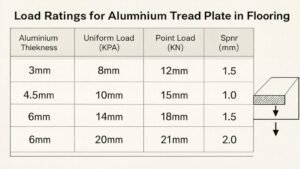
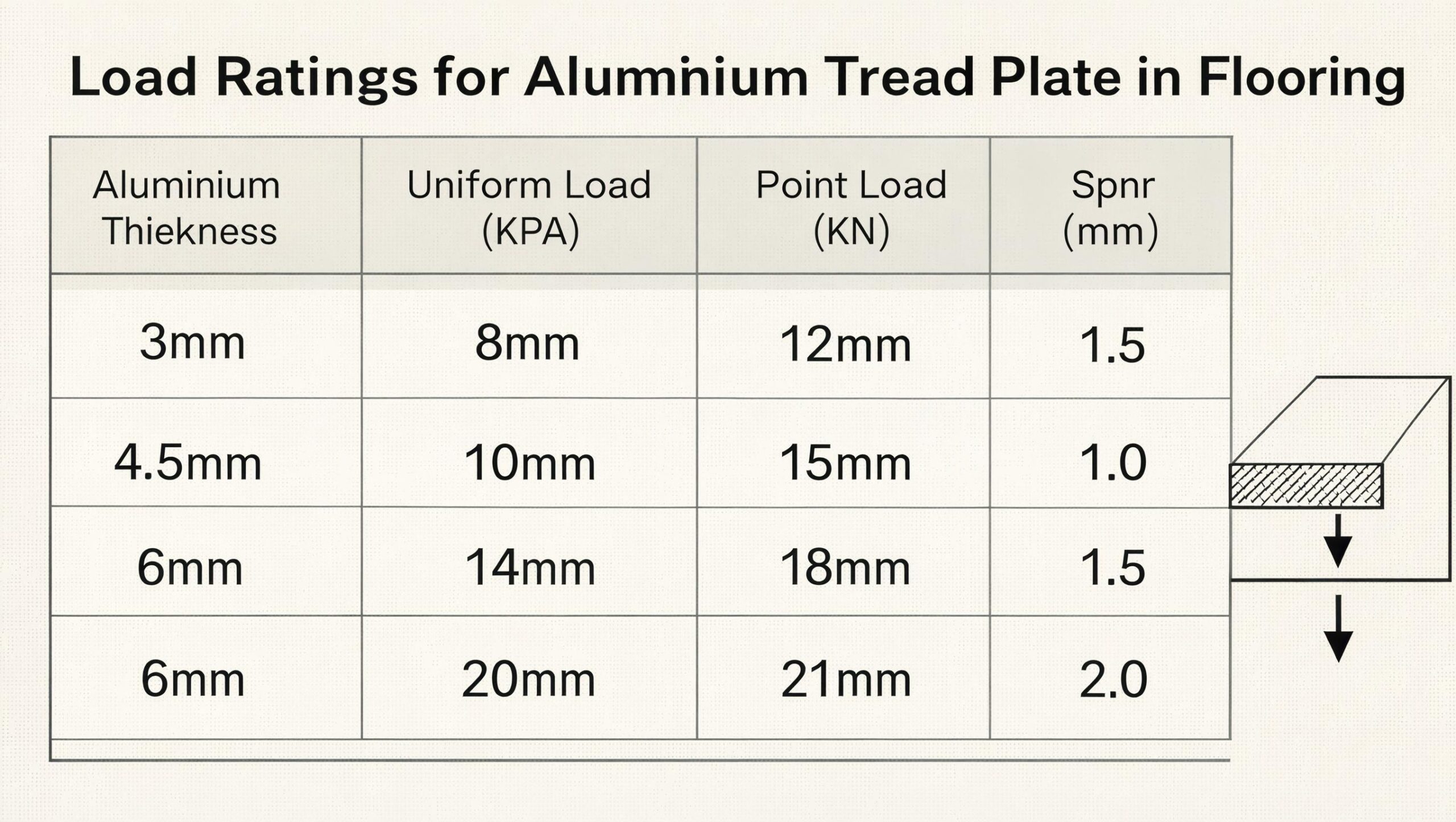
Load ratings are one of those details that seem straightforward until they cause a failure on site. Aluminium tread plate is widely used for walkways, platforms, vehicle floors, and access covers, yet many projects still rely on rough assumptions instead of proper load considerations.
In practice, the difference between a plate that performs well and one that bends, flexes, or fails often comes down to understanding how load ratings actually work. It is not just about thickness. It is about how the plate is supported, how the load is applied, and what kind of stress it will face over time.
What Load Ratings Actually Mean
Load rating refers to the amount of weight a material can safely support without excessive deflection or structural failure. With aluminium tread plate, this usually involves two key factors.
First is the maximum load the plate can carry. Second is how much it deflects under that load.
Deflection is often overlooked, but it matters just as much as strength. A plate might not break, but if it flexes too much, it can become unsafe or uncomfortable to use.
Industry guidelines often define acceptable deflection limits depending on the application. For example, flooring systems may require stricter limits than structural covers.
Why Thickness Alone Is Not Enough
One of the most common mistakes is assuming that thicker plate automatically solves load issues.
Thickness plays a role, but it is only part of the equation. The way the plate is supported has an even greater impact. A thinner plate with close support spacing can outperform a thicker plate with wide gaps between supports.
Span distance is critical. The longer the unsupported span, the more the plate will flex under load. Even small increases in span can lead to noticeable changes in performance.
A workshop supervisor once explained it simply. They said most problems they see are not because the plate is too thin, but because it is asked to span too far.
Point Loads vs Distributed Loads
Not all loads behave the same way, and this is where many designs fall short.
A distributed load spreads weight evenly across the surface. This is typical for foot traffic or evenly placed equipment. Aluminium tread plate handles this type of load relatively well.
A point load concentrates weight in a small area. This happens with wheels, machinery feet, or heavy equipment. Point loads create higher stress in specific areas, increasing the risk of deformation.
For example, a plate that performs well under foot traffic may struggle under the weight of a trolley or forklift wheel. This is why load calculations need to consider how the weight is applied, not just how much weight there is.
Material Grade and Its Impact on Load Capacity
The alloy used also influences how the plate performs under load.
Higher strength grades like 5052 provide better resistance to bending and deformation. They are often used in applications where durability and load capacity are important.
Lower strength grades such as 3003 are more suited to lighter applications. They offer good corrosion resistance and workability but may not hold up as well under heavier loads.
Choosing the right material is just as important as selecting the right thickness. In many cases, upgrading the alloy can improve performance without significantly increasing weight.
Support Structure and Installation Considerations
The support structure beneath the plate is often the deciding factor in real world performance.
Closely spaced supports reduce deflection and improve load capacity. Wider spacing increases the risk of flexing, even if the plate itself is relatively thick.
Fixing methods also matter. Plates that are properly secured at multiple points tend to distribute load more effectively. Loose or poorly fixed plates can shift under load, creating uneven stress.
In transport applications, such as trailer floors, the underlying frame plays a major role. A well designed frame can allow for thinner plate while still maintaining strength.
Real Applications and What They Require
Different applications place different demands on aluminium tread plate.
Walkways and platforms
These typically involve distributed loads from foot traffic. The focus is on limiting deflection and maintaining a stable surface. Thinner plate can work if supports are close enough.
Vehicle flooring
Ute trays and trailers often deal with mixed loads. Tools and cargo create distributed weight, while wheels and equipment introduce point loads. Stronger alloys and careful support design are usually required.
Industrial environments
Factories and warehouses may expose plates to heavy equipment, repeated impact, and high traffic. In these cases, both thickness and alloy strength become more important.
Understanding these differences helps avoid over engineering in some areas and under engineering in others.
Balancing Cost and Performance
Cost always plays a role in material selection. Thicker plates and higher grade alloys come at a higher price.
However, reducing material cost without considering load requirements can lead to higher expenses later. Repairs, replacements, and safety issues can quickly outweigh any initial savings.
This is where working with experienced suppliers of checker plates aluminium becomes valuable. They can help match the material to the application, ensuring that performance requirements are met without unnecessary cost.
In many projects, the most cost effective solution is not the cheapest material, but the one that performs reliably over time.
Common Mistakes to Avoid
One frequent mistake is ignoring deflection limits. A plate that does not break can still be unsuitable if it flexes too much.
Another is underestimating point loads. Wheels and concentrated weight can create stress that exceeds the plate’s capacity, even if overall load seems reasonable.
Some projects also overlook the importance of support spacing. Increasing support frequency can often solve load issues more effectively than increasing thickness.
Finally, selecting material based solely on availability rather than performance requirements can lead to compromises that affect the final outcome.
How to Approach Load Rating Decisions
A practical approach starts with understanding the type of load the plate will carry. Identify whether it is primarily distributed, point load, or a combination of both.
Next, consider the span between supports. This often has the greatest impact on deflection.
Then evaluate material options. Higher strength alloys may provide better performance without excessive thickness.
Finally, factor in installation conditions. Proper fixing and support design can significantly improve load capacity.
Final Thoughts on Aluminium Tread Plate Load Ratings
Load ratings are not just a technical detail. They are a key part of ensuring that aluminium tread plate performs safely and reliably in real conditions.
By looking beyond thickness and considering load type, span, material, and support structure, it becomes much easier to make informed decisions.
In the end, the goal is not simply to choose a plate that can carry the load, but one that does so consistently over time without unnecessary maintenance or risk.